Note: This is not a formal academic lesson. I am not a Computer Science graduate, and I didn’t learn this from a textbook. I learned it the hard way through a failed interview and a decade plus of professional intuition. This guide is for the practitioners who care more about how a thing works than what it’s called.
Following my last post, I realized that while I finally knew the name of the game, I never actually shared the rules. If you’re like me and you’ve spent years solving problems by intuition rather than by textbook, the term “Binary Search” can feel like a wall. But the logic itself is actually quite simple.
Think of it not as a complex algorithm, but as a pyramid of elimination.
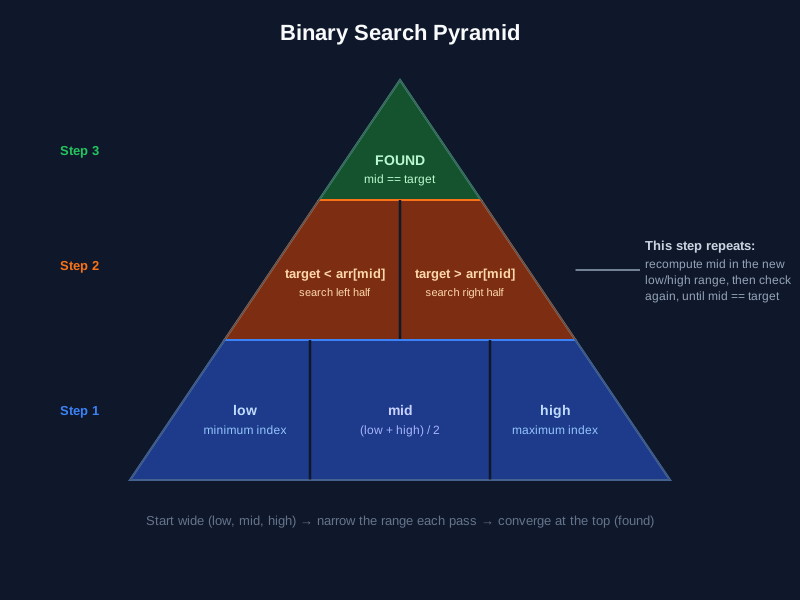
The Foundation: Min, Middle, and Max
At the base of the pyramid, we have three primary anchor points: the Minimum, the Middle, and the Maximum.
Imagine you are looking for a specific page in a 1,000-page book. You don’t start at page one and flip every page. That’s a linear search, and it’s a waste of time. Instead, you look at the very start (Min), the very end (Max), and then you dive straight into the center (Middle).
By identifying these three points, you’ve already defined the boundaries of your world.
The Middle Tier: The Great Divide
Once you’ve found the middle, the magic happens. You ask one simple question: Is the value I’m looking for higher or lower than this middle point?
- If the value is higher: You can instantly throw away the entire left side of the pyramid. Everything from the Min to the Middle is now irrelevant. Your new “Max” becomes the old “Middle.”
- If the value is lower: You discard the right side. Everything from the Middle to the Max is gone. Your new “Min” becomes the old “Middle.”
You’ve just deleted half of your problem.
The Apex: The Result
You repeat this process. Middle, compare, discard. Half the data goes away, then a quarter, then an eighth.
The pyramid narrows quickly. Eventually, the range becomes so small that you reach the top point. At this apex, you either find your value or you realize it simply isn’t there.
The beauty of this approach is its efficiency. In that 1,000-page book, you don’t need to look at 1,000 pages. You only need to check about 10.
The Binary Instinct
What’s fascinating is that we likely do this intuitively all the time. In almost everything we do mathematically, we can throw away 50% of the search space instantly.
When navigating a graph, you almost immediately know if you need to move right, left, or up, which negates the need to look behind; at most, you’re moving in an ordinal direction. In orienteering, knowing that 180 degrees is sufficient for a general direction allows you to ignore a significant portion of your map. In almost every real-world scenario, we are probably performing a mental binary search at an incredibly quick speed.
Binary search is just the formal name for that instinct: the art of consistently ignoring the half of the world that doesn’t contain your answer.